


Data storage
During each satellite pass the Belgian User Support and Operations Centre (B.USOC) acquires the raw data from the EPT instrument and ancillary data from the ESA control center in Redu. The BUSOC then performs the initial data processing and makes the result available to the Center for Space Radiations (CSR).
It also serves as a relay for the instrument configuration on board and assures the storage of data processed by the scientists.
Data treatment
The basic idea of EPT is to constitute a block with only a small number of active detectors (around 10) separated by layers of well chosen (and less expensive) inert materials (not active) with calibrated widths that we call digital absorber modules.
Each detector gives an electric signal "1" if it is traversed by a particle and "0" in the contrary case.
 The measurement of the penetration distance is obtained by counting simply the number of detectors that gave a signal or more precisely by registering the so-produced binary number. We know then that the energy of the particle is included in a specific energy range called channel.
The electronic treatment of the signal onboard the satellite is then simply the registered number (of hit detectors) corresponding to the energy of each incident particle. The conversion of this binary number in energy is known by the calibrations realized at the ground with particle accelerators before the launch.
In the space radiation belts the EPT instrument will measure the high energy fluxes of:
- 2-10 MeV electrons
- 4-300 MeV protons
- 10-1000 MeV He ions
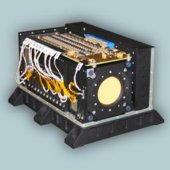
Due to the widely varying fluxes of electrons, protons and heavy ions within the radiation belts, the instrument has a stunning in-flight particle discrimination capability that provides more precise measurements than those made by previous detectors.
The observations are used to complete the empirical dynamic model of the space radiations developed at UCL and BIRA-IASB to predict the flux variations during geomagnetic storms.
This spectrometer also provides new measurements of the spectra of electrons, protons and heavier ions at high energy ranges. This is crucial because a considerable part of the range of the NASA radiation belt models (especially at high energy) was achieved by extrapolation.
Results
- 5 years of EPT observations (Annual Report 2017-2018)
- Radiation belts during geomagnetic storms observed by EPT (Annual Report 2019-2020)


